
What Are Refractory Fire Bricks and Why Are They Essential for High-Temperature Applications?
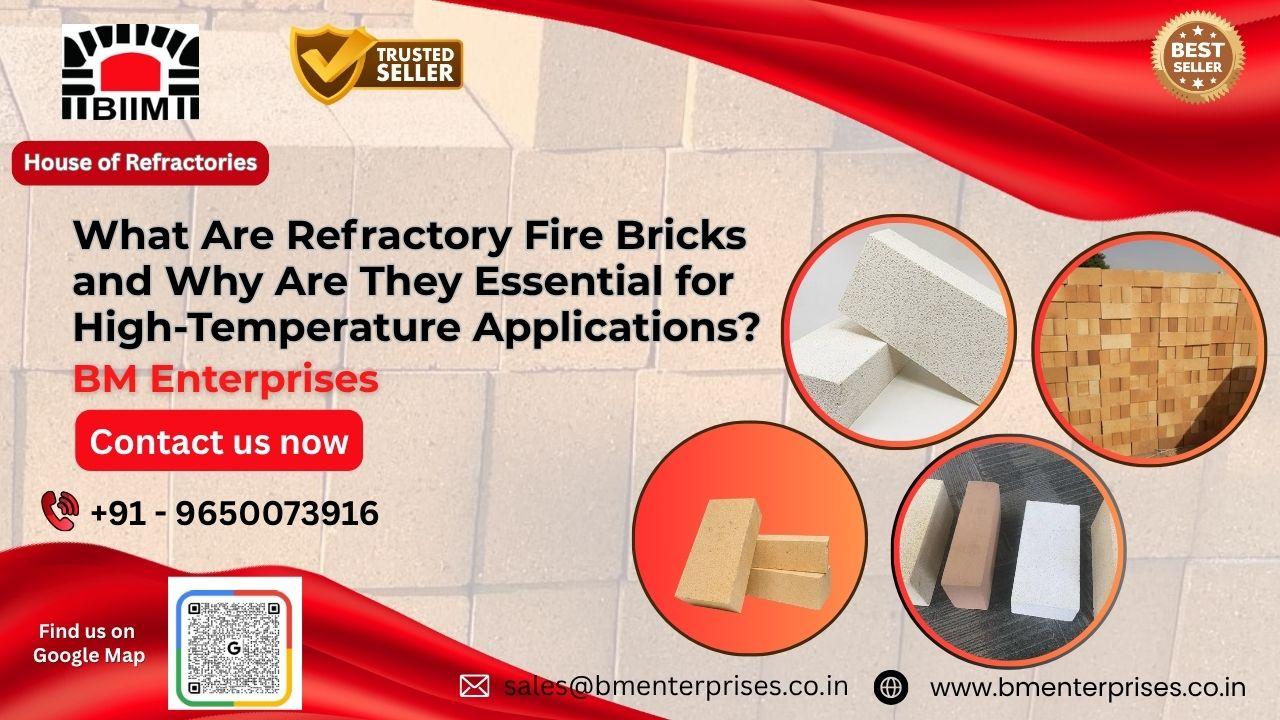
Introduction to Refractory Fire Bricks
Wherever industries are exposed to temperatures that are extremely high, it becomes impossible for regular building bricks to survive. In such cases, fire bricks become the most basic and essential part of thermal insulation systems. These bricks are designed and manufactured in such a way that they are capable of bearing temperatures ranging between 1,300°C and 1,750°C. While some types of bricks made from high alumina materials may be capable of withstanding much higher temperatures.
The latest industry figures reveal that the fire clay bricks usually withstand temperatures of about 1,300°C, while the superior quality alumina grade bricks can bear temperatures exceeding 1,750°C. At BM Enterprises, such products find their application in furnaces, boilers, kilns, incinerators, and industrial ovens where thermal efficiency is mandatory. It is like an armour plating in a spacecraft that resists the friction caused by entering the Earth's atmosphere.
Simple Definition of Fire Bricks
The most basic explanation of refractory fire bricks can be made by describing them as heat-resistant blocks of ceramics that have been produced through the firing of special materials like fire clay, alumina, silica, and other ceramic materials. While ordinary red bricks are fired at lower temperatures, fire bricks are produced at very high temperatures so that they can maintain their form even under high temperatures of fire, molten metals, or furnace heating systems.
Those who need a fire brick manufacturer in India or a fire brick supplier in India need to know that, depending on use, the material and quality of bricks will differ significantly. In this regard, fire bricks designed for a pizza oven will vary considerably from fire bricks installed within a steel furnace. BM Enterprises provides specialised fire bricks like fire clay bricks, insulating bricks, high alumina bricks, and ceramic bricks based on service conditions.
How They Differ from Normal Bricks
One of the main questions that may be asked by customers is: "Why don't you employ regular bricks?" And again, the reply will be clear: regular bricks were created for building structures, not for fires. While ordinary masonry bricks start cracking, softening, and losing their mechanical properties with higher temperatures, refractory bricks were developed to have a porous structure, low thermal expansion, and high refractoriness.
According to recent market requirements, fire bricks exhibit compressive strength of 200–600 kg/cm², high abrasion resistance, and low shrinkage at high temperatures. Hence, in comparison with ordinary bricks, which act like wax close to fire, fire bricks act like stone.
Composition and Manufacturing
The quality of refractory bricks is highly dependent on the purity of raw materials and the firing process. Materials used are usually bauxite, fire clay, chamotte, alumina, silica, and ceramic aggregates. In the case of high alumina bricks, the percentage of Al₂O₃ may range from 40% to 90%, depending on the application.
Production methods include crushing, sieving, mixing, moulding, drying, and firing in the kiln. The high temperature achieved during the firing process results in a very compact structure, making the bricks resistant to wear and tear. BM Enterprises takes into account size precision, composition consistency, and brick selection when delivering quality products to customers.
Main Types of Fire Bricks
The most commonly used classification systems involve:
Fire Clay Bricks
Fire clay bricks are the most cost-effective and adaptable fire clay bricks, and can withstand temperatures of up to around 1,300 °C. These bricks are perfect for boilers, ovens, kilns, and small-scale furnaces.
Insulating Bricks
Insulating bricks are low-density materials with low thermal conductivity (0.1–0.6 W/m·K). This material is highly effective for energy-efficient brick linings.
High Alumina Bricks
Alumina bricks are designed to withstand tough working conditions and have excellent resistance against slag at extremely high temperatures (1,700°C +).
Ceramic Bricks
High-quality ceramic bricks are widely used in applications requiring both heat shock resistance and corrosion resistance, including the glass and metallurgical industries.
Technical Specifications
Here is a quick technical comparison table:
| Brick Type | Temperature Range | Key Feature | Best Use |
| Fire Clay Bricks | Up to 1300°C | Cost-effective | Boilers, ovens |
| Insulating Bricks | 1100–1300°C | Low heat loss | Backup lining |
| High Alumina Bricks | 1700–1750°C | High strength | Steel, cement |
| Ceramic Bricks | 1400–1650°C | Thermal shock resistant | Glass furnaces |
The exact specifications vary by grade, but buyers usually focus on:
- Alumina %
- Bulk density
- Cold crushing strength
- Porosity
- Thermal conductivity
- Refractoriness under load
Applications of Refractory Fire Bricks
- Boilers and furnaces for heat insulation and protection against high temperatures
- Steel works in blast furnaces, ladles, reheating furnaces, and tundishes
- Cement rotary kilns with preheater, calciner, and burning sections
- Glass melting tanks and ceramic kilns, where thermal expansion resistance is important
- Power stations and incinerators for combustion chambers and ash zones
- Chemical process vessels subject to corrosive atmospheres and thermal shock
- Furnaces for foundry operations in crucibles, forging fires, and melting zones
- Industrial ovens, chimneys, fireplaces, and pizza ovens for heat storage and insulation
Key Features of Refractory Fire Bricks
- Superb heat resistance capacity at temperatures ranging from 1600 to 1800 degrees Centigrade and above, depending on type
- Thermal shock resistance to endure sudden changes in temperature
- Superior mechanical strength that makes it suitable for industrial applications where heavy loads need to be supported
- Lower thermal conductivity ensures minimal loss of heat, as well as increased fuel savings
- Resistance to abrasion and wear
- Immunity to chemicals and slag due to acid and alkaline atmosphere immunity
- Long life with low maintenance costs and less downtime
- Several types, including fire clay brick, insulating bricks, high alumina bricks, and ceramic bricks
Why Refractory Bricks Are Essential
Why do we need to have such bricks? Because heat is costly, and uncontrollable heat can be hazardous. The refractory brick will help to decrease heat loss, maximise fuel efficiency, keep internal temperature steady, and safeguard valuable industrial machinery.
A quality refractory lining can greatly enhance efficiency by saving fuel and minimising downtime. This will lead to lower costs associated with maintenance, increased productivity, and improved safety at work sites. For BM Enterprises' clients, it represents tangible benefits beyond just purchasing materials once.
Conclusion
Refractory bricks are more than just heat-resistant blocks; they are key components for successful high-temperature operations. Starting from fire clay bricks, high alumina bricks, insulating bricks, and ceramic bricks, each grade has its own particular role to play in terms of heat. Their remarkable heat resistance and chemical properties make them indispensable in boilers, furnaces, kilns, and industries.
If you are on a hunt for reliable refractory fire brick manufacturers in India or fire brick suppliers in India, then look no further than BM Enterprises.
FAQs
1. Refractory fire bricks consist of what?
The primary materials are fire clays, alumina, silica, ceramics, and heat-resistant aggregates.
2. To what temperature level do fire bricks resist?
The resistance varies from 1,300°C to 1,750°C+ depending on the grade of bricks.
3. In which industries is fire brick clay utilised?
These materials are often employed in boilers, kilns, ovens, furnaces, and fireplaces.
4. For what purposes are insulating bricks applied?
The utilisation allows for reducing heat losses, saving energy, and lowering fuel costs.
5. Is there any difference between fire clays and high alumina bricks?
Fire clay bricks are perfect for moderate heat, while high alumina ones are superior at extreme temperatures.

 English
 Arabic
 French
 Spanish
 Portuguese
 Deutsch
 Turkish
 Italiano
 Russian
 Romaian
 Portuguese (Brazil)
 Greek
Greek