
How Payroll HR Solutions Help Construction Companies Improve Workforce Management and Payroll Accuracy
Introduction
Most construction companies still lose money every month because of one avoidable problem. Payroll HR solutions fix it, and the companies using them are pulling ahead fast.
Here is what that problem looks like in practice. You have workers spread across three active job sites. Each site runs on different shift timings. Some workers are on hourly wages, others on day rates. A few have already crossed overtime. Two new joiners started this week. And someone still needs to collect attendance sheets from Site B before Friday.
That is a standard week for most mid-size construction firms. And when any part of that chain breaks, a timesheet goes missing, overtime gets missed, a new worker does not get added in time, someone gets paid wrong.
Construction workforce management has always been more demanding than other industries. You are not managing a fixed office team. You are managing mobile workforces across multiple locations, dealing with project-based hiring cycles, tracking daily attendance against shifting schedules, and making sure all of it stays within labor law boundaries.
Doing that manually is not just slow. It is a structural risk to your business.
A 2023 survey by the American Payroll Association found that companies relying on manual payroll processing see error rates of 1 to 8 percent per payroll cycle. In construction, where labor typically makes up 30 to 50 percent of total project cost, even a 2 percent error adds up to thousands of dollars in corrections, disputes, and rework.
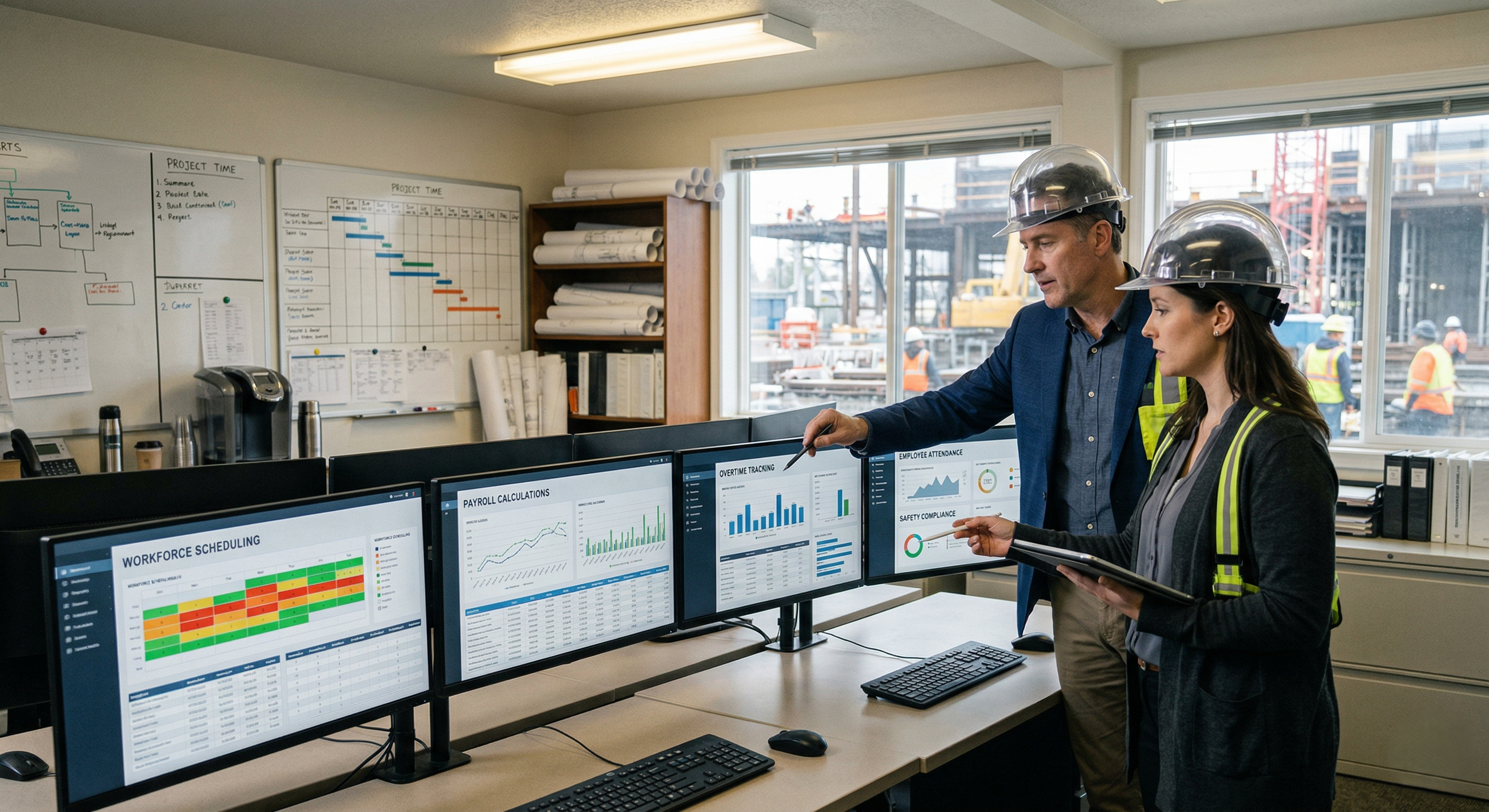
This is exactly why payroll HR solutions have become essential for construction companies that want to grow. These platforms bring HR management and payroll processing together in one system. They eliminate manual data entry, automate overtime and tax calculations, and give managers a real-time view of labor costs across all active sites.
This article breaks down the specific HR and payroll challenges construction firms face, explains how modern payroll HR solutions work, and shows the direct business benefits companies experience after making the switch.
Common HR and Payroll Challenges in Construction
The challenges construction companies face with payroll and HR are not unique to any one firm. They show up across the industry, and most of them come from the same root cause: manual processes trying to keep up with a workforce that never stays in one place.
Managing Multiple Job Sites and Shifts
A worker might clock in at Site A on Monday, get reassigned to Site B by Wednesday, and finish the week splitting time between both. That mobility is normal in construction. Tracking it accurately on paper or in spreadsheets is not.
When different supervisors manage attendance at different sites, data arrives in different formats, on different schedules, and with different levels of accuracy. HR teams end up spending hours every week reconciling conflicting records before they can even start processing payroll.
Without a centralized system, this problem compounds over time. Each payroll cycle carries forward errors from the last, and the team spends more time fixing mistakes than managing the workforce.
Tracking Attendance and Overtime
Overtime is one of the biggest cost variables in construction payroll, and it is also one of the easiest to get wrong manually.
Labor laws set clear thresholds for when overtime rates kick in, whether based on daily hours, weekly hours, or specific shift conditions. When attendance is tracked by hand, supervisors miss these thresholds regularly. Workers end up underpaid, creating disputes, or overpaid, draining the budget without anyone noticing until month-end reviews.
According to the U.S. Bureau of Labor Statistics, construction consistently records some of the highest overtime rates across all industry sectors. Without automated tracking, companies discover cost overruns only after payroll has already been processed and funds have gone out.
Payroll Disputes and Delayed Processing
Manual payroll cycles are slow. Collecting data, verifying it, doing the calculations, and getting approvals can stretch from two days to over a week. When something goes wrong, and it does, the cycle extends further.
Workers who get paid late or incorrectly lose trust fast. In a sector where skilled labor is already hard to retain, a pattern of payroll errors accelerates turnover.
Resolving disputes makes things worse. HR has to trace back through records, verify supervisor entries, and cross-check multiple data sources. That takes significant time, and none of that time was budgeted into any project.
|
Challenge |
Risk With Manual Process |
Business Impact |
|
Multi-site attendance |
Missing or conflicting timesheets |
Inaccurate wage calculations |
|
Overtime tracking |
Threshold breaches go undetected |
Budget overruns and disputes |
|
Payroll cycle speed |
Manual consolidation takes days |
Delayed pay, low morale |
|
Compliance management |
Rules applied inconsistently |
Penalties and legal exposure |
|
Employee records |
Paper files scattered across sites |
Slow onboarding and offboarding |
How Payroll HR Solutions Work
Payroll HR solutions are integrated platforms that connect HR management functions directly to payroll processing. Instead of tracking attendance in one tool, storing HR records in another, and doing payroll calculations in a spreadsheet, everything runs inside one connected system.
Integrated Attendance and Payroll Tracking
Modern payroll HR solutions capture attendance in real time through mobile apps, biometric devices, or GPS-enabled check-ins. When a worker arrives at a job site, that data flows directly into the payroll engine.
No manual entry. No end-of-week data chasing. No missing timesheets.
The system tracks hours worked, break durations, shift types, and site assignments continuously. When a worker approaches their overtime threshold, the system flags it automatically. At the end of the payroll cycle, calculations pull from clean, verified data, not from a pile of handwritten forms.
This is the core mechanic behind accurate payroll. Payroll HR solutions enable HR managers to run accurate payroll because the input data is accurate before the cycle even starts.
Employee Record Management
Every employee generates documentation throughout their time with a company. Contracts, certifications, site assignments, leave history, pay revisions, and exit documents all need to be stored and accessible.
Payroll HR solutions consolidate all of this in one place. When a worker changes site assignments or gets a pay revision, the system updates across all connected modules automatically. Managers at any authorized location can access current records without digging through filing cabinets or email chains.
For construction companies with seasonal hiring cycles, this centralized record management also makes it much easier to rehire past workers, verify certifications quickly, and maintain compliance documentation across large rotating workforces.
Automated Payroll Processing
Once attendance is verified, payroll HR solutions handle the rest automatically. The system applies pay rates, overtime rules, tax deductions, provident fund contributions, and any other statutory requirements — and generates payslips without manual calculation.
Payroll managers get a consolidated summary before anything goes out. The system flags exceptions for review. Approvals go through digital workflows. The whole cycle runs faster and with far fewer errors.
Research from Deloitte's HR Technology practice shows that companies using integrated payroll HR platforms reduce their payroll processing time by an average of 40 percent compared to those using separate tools or manual methods.
Improving Workforce Management
Payroll HR solutions do more than process wages. They give construction companies practical tools to manage their workforce more effectively at every stage of the employee lifecycle.
Better Labor Allocation
When managers can see real-time data on who is working where, how many hours each worker has logged, and where overtime risk is building, labor allocation becomes a data-driven decision instead of a guessing game.
A supervisor planning next week's crew can open the system, see which workers have available capacity, identify who is close to their overtime limit, and distribute the workload across sites accordingly. That kind of planning keeps projects on schedule and keeps labor costs predictable.
Payroll HR solutions enable project managers to make faster staffing decisions because the data they need is always current and in one place.
Faster Onboarding and Offboarding
Construction projects hire in bursts. When a new contract starts, a company might bring on 20 workers in under two weeks. When a project wraps, the workforce scales back just as fast.
Payroll HR solutions streamline both sides of this cycle. New worker profiles are created in the system, documents are uploaded, pay structures are assigned, and the worker is active from day one. No paperwork pileup. No delayed first paycheck.
Offboarding follows the same path. Exit checklists, final settlements, and document archiving all happen within the platform. HR teams save hours on administrative work, and records remain complete and auditable after the worker leaves.
Transparent Employee Records
One of the most underused benefits of payroll HR solutions is what they do for trust between employees and management. When workers can view their own attendance logs, leave balances, and pay breakdowns through a self-service portal, they stop questioning whether the numbers are right.
Most payroll disputes happen because employees have no visibility into how their pay was calculated. When that data is accessible and verifiable, dispute rates fall significantly.
Managers benefit from the same transparency. When a project lead asks why labor costs ran high last month, HR can produce a full breakdown by site, shift, and individual worker within minutes.
Enhancing Payroll Accuracy and Compliance
Payroll accuracy in construction is both a financial and a legal matter. Labor laws govern overtime rates, minimum wage requirements, mandatory deductions, and benefits contributions. Getting these wrong creates penalties that go well beyond the cost of the original error.
Automated Overtime Calculations
Payroll HR solutions calculate overtime based on rules you configure once, whether your contracts follow daily thresholds, weekly limits, or project-specific conditions. The system applies the correct rate every time, for every worker, on every site.
This eliminates one of the most persistent sources of payroll error in construction. There is no more manually checking each worker's hours against a threshold at the end of a long week. The system does it at scale and flags exceptions before the cycle closes.
Project managers also get ahead of costs. Configurable alerts notify supervisors when a worker is approaching their overtime limit, giving them a chance to reassign work before additional expenses kick in.
Tax and Labor Law Compliance
Statutory deductions, tax, provident fund, professional tax, and others, vary by worker type, pay level, and state or region. Applying these correctly through manual calculation is genuinely difficult, and a single consistent error across a large workforce creates real legal exposure.
Payroll HR solutions maintain current tax tables and apply the correct deductions automatically based on each worker's profile and jurisdiction. When rules change, the system updates. Your compliance does not depend on someone remembering to update a spreadsheet formula.
According to the Society for Human Resource Management, payroll compliance errors cost U.S. businesses more than seven billion dollars annually in penalties and back pay. Automated payroll HR solutions are the most reliable way to reduce that exposure.
Digital Approvals and Audit Trails
Every action in a well-built payroll HR solution leaves a timestamped record. Attendance was approved by this supervisor. Overtime was flagged and signed off by this manager. The payslip was generated and sent at this time.
These audit trails give construction companies a clean response to any dispute or compliance inquiry. Instead of digging through email histories and paper files, HR can pull up a complete record of every decision within seconds.
Digital approvals also accelerate the payroll cycle itself. Supervisors approve timesheets from mobile devices. HR reviews summaries and confirms payroll runs without waiting for physical sign-offs. The entire process moves faster and leaves far fewer gaps.
|
Manual Payroll Process |
With Payroll HR Solutions |
|
Timesheets collected by hand each week |
Real-time attendance captured digitally |
|
Overtime calculated manually per employee |
Automated threshold tracking with alerts |
|
Tax rules applied inconsistently |
Tax tables updated automatically |
|
Approvals via email or paper sign-off |
Digital approvals with full audit trail |
|
Errors discovered after payroll closes |
Exceptions flagged before processing |
|
Records scattered across sites and files |
Centralized, searchable employee records |
Benefits for Construction Businesses
When construction companies implement payroll HR solutions properly, the impact shows up across the business, not just inside the HR function.
Improved Employee Satisfaction
Workers who get paid correctly and on time stay longer. That is not complicated, it is just true. In construction, where skilled labor is expensive to find and replace, payroll reliability has a direct effect on retention rates.
Payroll HR solutions enable companies to pay workers accurately, explain pay breakdowns clearly, and resolve discrepancies quickly when they do occur. Self-service portals give workers direct access to their own records, reducing the number of queries HR has to handle and giving employees more confidence in the process.
Companies that reduce payroll errors consistently report higher scores on employee satisfaction surveys, particularly around pay transparency and administrative responsiveness.
Reduced Payroll Errors
Payroll errors in construction do not stay contained. An underpayment this week becomes a correction and a trust issue next week. A missed overtime calculation last month may require a compliance review and back pay calculation that takes days to sort out.
Payroll HR solutions reduce errors at the source. Attendance data flows in automatically. Calculations follow configured rules. Approvals go through structured digital workflows. The result is fewer errors to begin with, and faster resolution when something does need to be corrected.
Companies that switch from manual to automated payroll HR systems typically see error rates drop by more than half within the first few payroll cycles after implementation.
Better Project Cost Control
Labor is usually the biggest variable cost in any construction project. Without accurate, current labor data, project managers make decisions with incomplete financial information. That leads to budget overruns that only become visible weeks after they started.
Payroll HR solutions give project managers a real-time view of labor spend by project, by site, and by team. They can see exactly how much has been allocated at any point in the project timeline, compare it against the budget, and take corrective action before a small overrun becomes a big one.
That kind of cost visibility is what separates companies that consistently deliver projects on budget from those that do not.
Key benefits construction companies gain from payroll HR solutions:
• Payroll processing time reduced by 40 to 60 percent with integrated systems
• Significant drop in payroll error rates compared to manual calculation
• Real-time labor cost visibility across all active project sites
• Automated compliance with overtime rules and tax regulations
• Improved employee retention through accurate and transparent pay
• Faster onboarding and offboarding for project-based hiring cycles
• Clean audit trails for dispute resolution and compliance inquiries
Conclusion
Construction workforce management is genuinely difficult. Mobile workforces, multiple active sites, project-based hiring, shifting schedules, and strict labor law requirements all have to be managed simultaneously, and they all connect back to payroll.
Doing this manually is not just inefficient. It is a source of ongoing financial risk, compliance exposure, and employee dissatisfaction that compounds over time.
Payroll HR solutions give construction companies a way to manage all of this in one place, accurately, and with significantly less manual effort. They connect attendance data directly to payroll processing, automate compliance at every step, and give managers the cost visibility they need to keep projects on budget.
The companies that invest in payroll HR solutions are not just solving an administrative problem. They are building the operational foundation that makes it possible to take on larger projects, hire more confidently, and retain the skilled workforce that makes those projects successful.
If your company is still running payroll from spreadsheets and paper timesheets, the cost of staying manual is higher than you realize, in errors corrected, in hours wasted, and in the trust you lose with your workforce every time something goes wrong.
Ready to see what better looks like? Payroll Solutions is purpose-built for construction companies managing field workforces, multi-site operations, and project-based staffing. Book a Free Webinar for Construction Industry Payroll and get a live walkthrough of how the right payroll HR solution can cut your processing time, eliminate common errors, and give your project managers real-time cost visibility across every active site.

 English
 Arabic
 French
 Spanish
 Portuguese
 Deutsch
 Dutch
Dutch
 Italiano
 Russian
 Romaian
 Portuguese (Brazil)
 Greek
Greek