
Post-Mortem of a Network Failure: Why Single-SIM Systems Fail Even with 99% Coverage
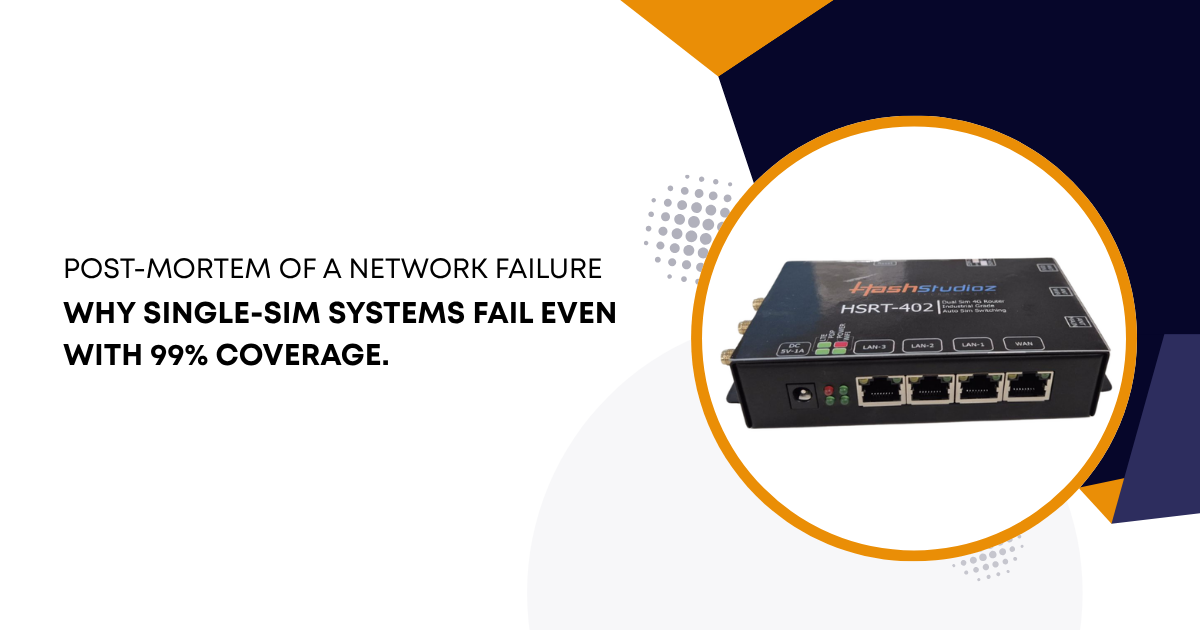
Most network providers brag about having 99% coverage. This number sounds perfect for business. In reality, that remaining 1% represents a massive risk. For an Industrial Router, 1% downtime equals 87 hours of failure per year. A single-SIM system relies on one tower and one carrier. If that tower fails, the system dies. We see this in remote monitoring and factory automation. Even in cities, signal shadows and maintenance cause drops. This article breaks down why a single-SIM setup is a ticking time bomb.
Why 99% Is Not Enough
Network uptime is often a marketing tool. It does not account for local interference. It ignores hardware congestion at the cell site. A 99% uptime rating seems high, but the math tells a different story.
1. The Math of Failure
Let’s look at the actual data for a single-SIM system:
-
Daily Downtime: 14.4 minutes.
-
Monthly Downtime: 7.2 hours.
-
Yearly Downtime: 3.6 days.
For a water treatment plant, three days of no data is a crisis. For a remote oil rig, it is a disaster. A single-SIM Industrial Router cannot bridge these gaps.
2. The "Dead Zone" Reality
Radio waves face many physical barriers. Concrete, steel, and glass block signals. Even weather affects 4G and 5G waves. A single carrier might have a strong signal outside. Inside a factory, that signal often vanishes. This is a common point of failure for fixed assets.
Anatomizing a Network Crash
How does a failure happen? It usually starts with a simple trigger. A "post-mortem" of these events shows clear patterns.
1. Carrier Core Maintenance
Carriers update their software at night. During these windows, the connection drops. A single-SIM device has no backup path. It stays offline until the carrier finishes the work. This might take minutes or hours.
2. Frequency Overload
Imagine a local festival or an emergency. Thousands of phones connect to one tower. The tower gives priority to emergency calls. Your Industrial Router loses its data slot. Without a second SIM, the device cannot jump to a less crowded network.
3. Hardware Fatigue
Cell towers are machines. They overheat. Lightning strikes them. When a tower goes dark, every single-SIM device in a five-mile radius stops. A Dual SIM Industrial Router would detect this loss in seconds. It would then shift to a different tower owned by a different company.
The Hidden Costs of Network Blind Spots
When we discuss 99% coverage, we often ignore the "where" and the "when." An Industrial Router does not sit on a desk in a climate-controlled office. It sits inside a steel cabinet in a remote field. It sits in the basement of a manufacturing plant. These locations turn 99% coverage into 50% coverage very quickly.
The "death by a thousand cuts" happens when micro-outages occur. These are drops that last only seconds. A consumer phone might not notice. However, a PLC (Programmable Logic Controller) will lose its heartbeat signal. This triggers a safety shutdown. A single-SIM system cannot recover fast enough to prevent the stop.
Mechanics of Signal Interference
Radio frequency (RF) environments in industrial zones are chaotic. High-voltage cables create electromagnetic interference (EMI). Large motors generate noise across the spectrum.
1. Multi-path Fading
In a warehouse, signals bounce off metal racks. This creates "ghost" signals. They arrive at the antenna at different times. A single-SIM Industrial Router struggles to decode these messy waves. If that specific carrier’s frequency is hit by fading, the link dies.
2. Signal Shadowing
Large physical objects like silos or cranes move. As they move, they block the line of sight to the cell tower. If your only SIM belongs to that blocked tower, your data stops. A Dual SIM Industrial Router uses a second carrier whose tower might be at a different angle. This ensures the signal path remains clear.
The Role of the Industrial Router
Industrial environments are harsh. They have high heat and vibration. Standard consumer routers fail here quickly. An Industrial Router uses rugged parts to survive. However, hardware toughness is only half the battle. Software intelligence matters more. A smart router needs to know when a signal is "zombie" data. This is when the bars are high, but no data moves.
Active vs. Passive Failover
-
Passive Failover: The router waits for a total disconnect. Then it switches. This causes a short delay.
-
Active Load Balancing: The router uses both SIMs at once. It sends data through the best path. This offers 99.99% uptime.
Technical Deep Dive: Failover Logic
How does a Dual SIM Industrial Router actually manage a failure? It uses a sophisticated logic tree.
1. ICMP Check (The Heartbeat)
The router sends a small packet (a "ping") to a reliable server every few seconds. If the packet does not return, the router knows the path is broken. A single-SIM device just keeps trying the same path. A dual-SIM device immediately tries the second path.
2. DNS Probing
Sometimes the connection looks "up," but the internet service provider (ISP) has a DNS failure. The router tries to resolve a web address. If it fails, it initiates the switch to the secondary SIM.
3. Link Quality Analysis
Modern routers look at more than just "up or down." They measure:
-
Latency: Is the data taking too long?
-
Jitter: Is the connection unstable?
-
RSSI: Is the signal strength dropping below a usable level?
If these metrics hit a threshold, the Dual SIM Industrial Router moves the traffic to the backup SIM. This happens before a total failure occurs.
Economic Consequences: The True Price of Cheap Hardware
Choosing a single-SIM router to save a little money is a classic mistake. Let’s look at the operational costs of a single network failure.
1. The "Truck Roll" Expense
A truck roll is the cost of sending a technician to a site.
-
Fuel and Vehicle: $50
-
Labor (4 hours): $200
-
Lost Opportunity: $250
-
Total: $500 per event.
If a single-SIM system fails twice a year, you have spent $1,000 on repairs. A high-quality Dual SIM Industrial Router pays for itself during the very first network outage. It fixes connection issues automatically.
2. Compliance and Penalties
In the energy sector, data gaps result in regulatory fines. In the food industry, a lost connection to a temperature sensor can trigger a "mandatory discard." You might throw away $50,000 of product because of a $10 network glitch. Redundancy is not a luxury; it is insurance.
Connectivity Protocols in Industrial Systems
Industrial data uses different protocols than Netflix or Zoom.
1. Modbus and MQTT
These protocols are "chatty." They send frequent, small updates. If the network jitters, the connection resets. A single-SIM router often gets stuck in a "reconnection loop." A Dual SIM Industrial Router provides the stable "always-on" pipe these protocols require. It keeps the handshake alive.
2. VPN Tunneling
Most industrial sites use a VPN for security. If a SIM loses its IP address, the VPN collapses. Rebuilding a VPN tunnel can take minutes. A dual-radio router maintains two tunnels at once. If one SIM fails, the data moves to the other tunnel instantly. The user sees zero lag. This is critical for remote desktop control.
Real-World Failure Examples
1. The Smart Grid
An electric company used single-SIM routers for pole sensors. A storm knocked out a major carrier tower. The company lost sight of the grid. They could not find the power breaks. This doubled the repair time. A dual-carrier setup would have kept the sensors online.
2. Cold Storage Logistics
A warehouse stored millions of dollars in medicine. The router lost signal for six hours. The cooling system failed to report a temperature spike. All the medicine spoiled. A Dual SIM Industrial Router would have sent an alert via the backup network.
Why Carriers Cannot Guarantee 100%
Even the best carriers face physical limits.
1. Fiber Cuts
Cell towers connect to the world via fiber optic cables. Construction crews often cut these cables by mistake. When a cable breaks, the entire tower goes dark. No amount of "99% coverage" helps you then. You need a second SIM on a different carrier that uses a different fiber path.
2. Software Glitches
In early 2024, a major US carrier suffered a 12-hour outage. A software update error caused the crash. Millions of devices went dark. Businesses with a Dual SIM Industrial Router simply switched to a competitor. They kept working. They did not lose a single minute of production.
Technical Barriers in Single-SIM Systems
1. Signal Throttling
Carriers slow down "heavy" users. If your device hits a data cap, it slows to a crawl. In a single-SIM setup, you are stuck with slow speeds. In a dual-SIM setup, the router switches to the fresh SIM. This maintains high data rates for video or large file transfers.
2. Handover Failures
Devices move between towers. Sometimes the "handshake" between towers fails. The device hangs in a "searching" state. A second SIM provides an immediate alternative path while the first SIM resets. This is vital for routers installed on buses or trains.
Statistics That Matter
Data shows the clear advantage of redundancy.
|
System Type |
Typical Uptime |
Annual Downtime |
Reliability Level |
|
Single SIM |
99.0% |
87.6 Hours |
Basic |
|
Dual SIM (Cold Standby) |
99.9% |
8.7 Hours |
Professional |
|
Dual SIM (Hot Swappable) |
99.99% |
52 Minutes |
Mission Critical |
Companies using dual-path communication report 40% higher reliability. They also see a 30% drop in operational costs over three years.
Security Benefits of Dual SIMs
A Dual SIM Industrial Router also helps with security. If one network faces a Cyber Attack, you can switch. It provides a "clean" path for urgent data. Some routers also allow "VPN bonding." This splits encrypted data across both SIMs. It makes it harder for hackers to intercept the full message.
Avoiding the "Denial of Service"
If a hacker floods a specific carrier network, your single-SIM device will stop. A dual-SIM system can sense the congestion. It then moves the traffic to the unaffected network. This keeps your command-and-control links alive during an attack.
Designing for Resilience: Best Practices
To maximize your uptime, follow these deployment steps:
-
Site Survey: Use a signal meter to check all carriers at your location.
-
Antenna Placement: Place antennas outside of metal enclosures. Use "MIMO" (Multiple Input Multiple Output) antennas for better speed.
-
Provider Separation: Ensure your two SIM cards do not share the same parent network. Many smaller brands use the same towers as the big names.
-
Regular Testing: Set the router to "test" the backup SIM once a month. This ensures the backup account is still active and paid for.
-
Firmware Updates: Keep your Industrial Router software current. New patches improve failover speed and security.
The Human Element: Peace of Mind
Reliability is about more than just machines. It is about the engineers who manage them. A single-SIM system creates "pager fatigue." Engineers get alerts at 3:00 AM for minor network drops.
A Dual SIM Industrial Router acts as an automated first responder. It fixes the problem before the engineer even gets an alert. This allows the team to focus on high-value tasks. They stop chasing signal ghosts and focus on optimization.
Future-Proofing with 5G
5G offers high speeds but lower range. It struggles with walls more than 4G. This makes the "99% coverage" claim even more fragile. Using a Dual SIM Industrial Router allows you to mix 4G and 5G. You get the speed of 5G and the reliability of 4G. As carriers retire older 3G and 4G bands, having two paths ensures you are never left behind during a "sunsetting" event.
Conclusion
Single-SIM systems are a gamble. You bet your business on a single provider's uptime. As we have seen, 99% coverage is not enough for modern industry.
Investing in a Dual SIM Industrial Router is the only way to ensure 24/7 connectivity. It eliminates the 1% gap. It protects your data, your equipment, and your profit. The post-mortem of any major network failure shows the same result. Reliance on a single path leads to disaster. Build a network that stays online regardless of the circumstances. Use dual-SIM hardware to turn 99% coverage into 100% reliability.

 English
 Arabic
 French
 Spanish
 Portuguese
 Turkish
 Dutch
Dutch
 Italiano
 Russian
 Romaian
 Portuguese (Brazil)
 Greek
Greek