
Why Do Businesses Need Enterprise UX Consulting Services to Improve User Experience?
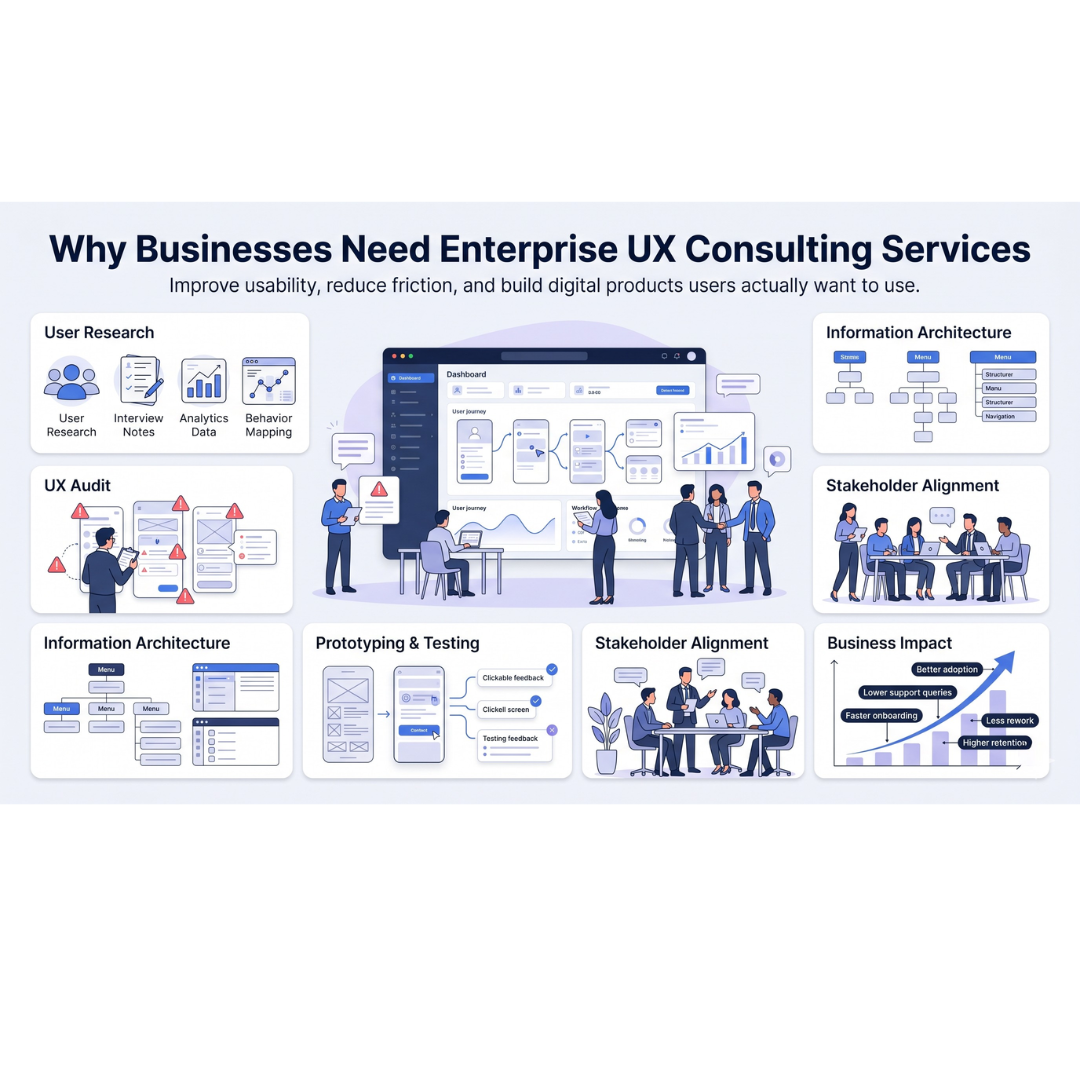
Businesses need enterprise UX consulting because most large-scale digital products fail not due to technology, but because they are built without understanding how real people actually use them. When internal teams are too close to a product, they stop seeing its friction points. An outside UX consultant brings structure, user research, and design clarity to fix what is quietly costing companies revenue, retention, and employee productivity.
That is the short answer. Here is the full picture.
The Scale Problem That Most Enterprises Ignore
Large organizations deal with a different class of UX problems than startups. They have legacy systems, multiple user groups, complex workflows, and products used by thousands of employees or customers daily.
A single confusing screen in an enterprise software tool can slow down hundreds of employees every day. Multiply that by months, and the cost becomes significant, even if no one has put a number on it yet.
This is where the problem starts: enterprise teams often treat UX as a design task rather than a business function. The result is products that look polished but perform poorly in real-world conditions.
What Actually Goes Wrong Without Proper UX Guidance
Here are the situations businesses find themselves in when UX is an afterthought:
-
Customer portals with high drop-off rates because the navigation makes no logical sense
-
Internal tools that require hours of training because nothing works the way employees expect
-
Mobile applications that technically function but frustrate users enough that they avoid them
-
Digital products that get rebuilt every two years because the original design never solved the real problem
These are not edge cases. They are standard outcomes when user experience is treated as something that happens at the end of development, not the beginning.
What Enterprise UX Consulting Actually Involves
People often confuse UX consulting with hiring a UI designer. They are not the same thing.
A UX consultant working at the enterprise level typically covers:
User Research and Behavior Analysis
Understanding who actually uses the product, what tasks they are trying to complete, and where they are failing. This is not guesswork. It involves interviews, usability testing, and analyzing real usage data.
Information Architecture
Organizing content, features, and workflows so they match how users think, not how the internal team thinks.
Interaction Design and Prototyping
Building testable versions of new flows before development begins, which prevents expensive mistakes downstream.
Stakeholder Alignment
One of the most underrated parts of enterprise UX work. Large companies have multiple stakeholders with competing opinions. A consultant brings structure to those conversations and grounds decisions in user data rather than internal politics.
Usability Audits
A structured review of an existing product to identify exactly where and why users struggle. This is often the fastest way to find quick wins in an existing product.
The Real Business Case for Investing in UX
Better user experience has measurable outcomes. Here is what businesses typically see when UX is done properly:
-
Reduced customer support load because users can complete tasks without help
-
Shorter employee onboarding because tools are intuitive from day one
-
Higher product adoption rates because users actually want to use the product
-
Fewer development rework cycles because design decisions were validated before building
The companies that see the most value from UX investment are not those with the biggest design budgets. They are the ones that treat user research and design as part of the product strategy, not as decoration applied at the end.
When Should a Business Bring in UX Consultants?
There is no single right moment, but these situations are clear signals:
-
You are planning a major product redesign or digital transformation initiative
-
Your current product has a high abandonment rate or low engagement metrics
-
You are building a new enterprise tool for internal or external users
-
Your development team is spending significant time fixing usability complaints post-launch
-
You are entering a new market and need to understand a different user base
If any of these apply, waiting longer only adds to the cost of the eventual fix.
Choosing the Right Partner for Enterprise UX Work
Not every design agency understands enterprise complexity. The right consulting partner should have experience with large-scale products, understand how enterprise workflows differ from consumer apps, and be able to communicate findings clearly to both designers and business decision-makers.
F1Studioz works with businesses at this level, combining user research, product strategy, and interaction design to address real usability gaps rather than surface-level design changes. If your business is dealing with a product that is not performing the way it should, that is exactly where enterprise UX consulting services make a measurable difference.
Conclusion
Enterprise UX is not a design luxury. It is a business function that directly affects how well your product performs, how quickly employees can work, and how satisfied your customers are. The companies that invest in it early spend less on rework and see stronger adoption across the board. The ones that skip it tend to rebuild the same product multiple times before realizing the problem was never the technology.
Frequently Asked Questions
Q.1 What is the difference between UX consulting and hiring a UX designer?
A UX designer typically executes design tasks within a defined scope. A UX consultant brings strategic thinking, conducts user research, evaluates existing products, and advises on design decisions at a business level. For enterprise projects, you usually need both.
Q.2 How long does an enterprise UX consulting engagement typically take?
It depends on the scope. A usability audit of an existing product can take two to four weeks. A full product redesign engagement with research, prototyping, and testing can run three to six months. Timelines vary based on complexity.
Q.3 Can enterprise UX consulting services help with internal tools, not just customer-facing products?
Yes, and this is one of the most valuable applications. Internal tools with poor usability reduce employee productivity every single day. Improving them often has a faster ROI than customer-facing improvements because the impact is immediate and measurable.
Q.4 What should a business prepare before engaging a UX consultant?
Having access to usage data, existing user feedback, a clear list of business goals, and key stakeholders who can participate in research sessions will make the engagement far more effective from day one.
Q.5 How do I know if my product actually has a UX problem versus a technical problem?
If users can complete the task but avoid doing so, or if they frequently ask for help with steps that should be self-explanatory, the issue is UX. If the product breaks, crashes, or produces errors, that is a technical problem. Often both exist together, and a usability audit helps separate the two clearly.

 English
 Arabic
 French
 Spanish
 Portuguese
 Deutsch
 Turkish
 Dutch
Dutch
 Italiano
 Russian
 Romaian
 Portuguese (Brazil)