
BIS FMCS Certification: Scheme, License & Certificate
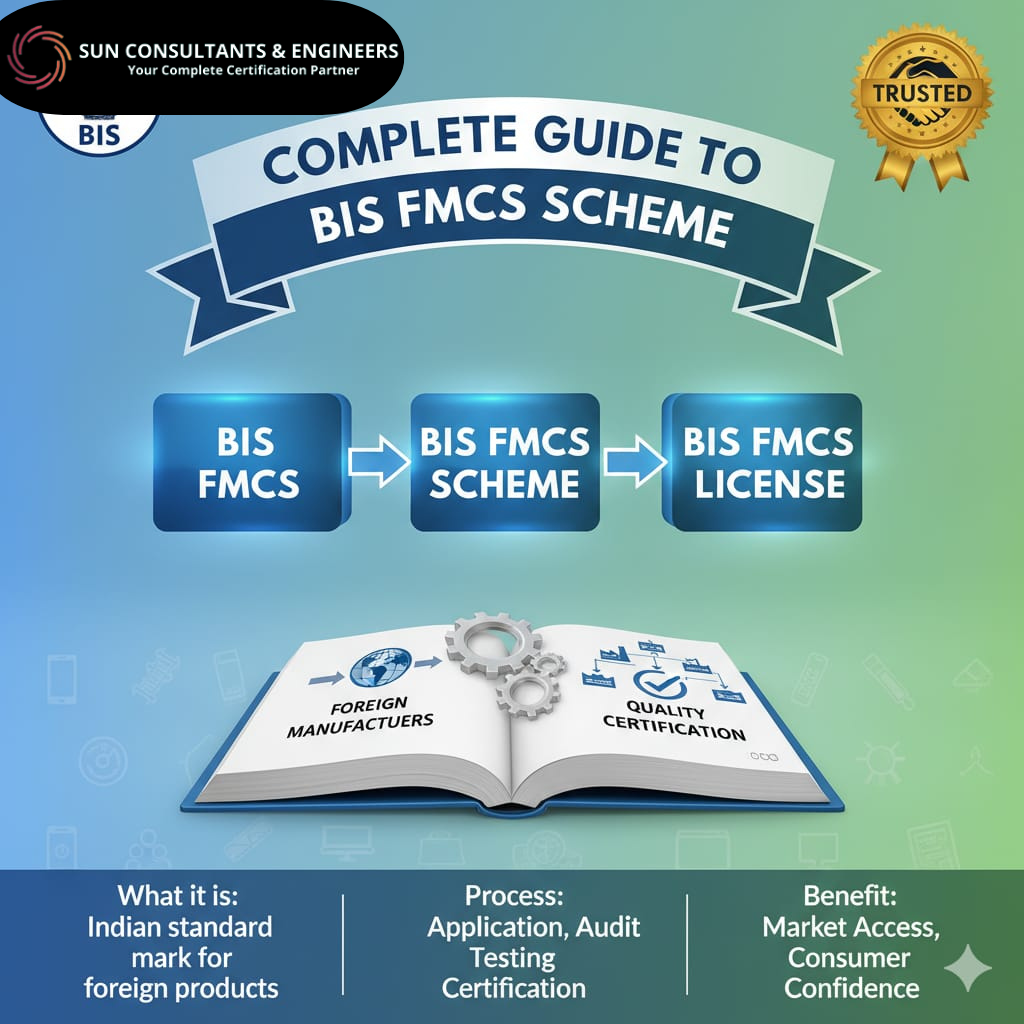
Introduction
The Indian market is one of the fastest-growing markets globally, attracting manufacturers from all over the world. However, to sell products in India, foreign manufacturers must comply with Indian quality and safety standards. This is where BIS FMCS becomes important.
The BIS FMCS Scheme is specifically designed for foreign manufacturers who want to export regulated products to India. This blog explains everything about BIS FMCS Certification, including the scheme, licensing process, and BIS FMCS Certificate in simple language.
What is BIS FMCS?
BIS FMCS stands for Foreign Manufacturers Certification Scheme. It is a certification system operated by the Bureau of Indian Standards to ensure that foreign-manufactured products meet Indian Standards (IS).
Under this scheme, foreign manufacturers are granted a BIS FMCS License, allowing them to use the ISI mark on their products sold in India.
What is the BIS FMCS Scheme?
The BIS FMCS Scheme was introduced to regulate the quality of imported products and protect Indian consumers. It ensures that products manufactured outside India comply with the same standards as domestically produced goods.
Key Objectives of the BIS FMCS Scheme:
-
Ensure product safety and quality
-
Control substandard imports
-
Maintain uniform Indian Standards
-
Protect consumer interests
Products such as electrical appliances, automotive components, steel items, and construction materials often fall under this scheme.
Who Needs BIS FMCS Certification?
BIS FMCS Certification is mandatory for:
-
Foreign manufacturers exporting regulated products to India
-
Overseas factories producing goods under mandatory BIS standards
-
Companies using Indian Standard (IS) marks on imported products
Without a valid BIS FMCS Certificate, products may be denied entry into the Indian market.
BIS FMCS Certification Process (Step-by-Step)
The BIS FMCS Certification process is systematic and requires strict compliance. Below is a simplified explanation:
Step 1: Identify Applicable Indian Standard
Determine whether your product is covered under mandatory BIS certification and identify the relevant Indian Standard (IS).
Step 2: Application Submission
The manufacturer submits an online application under the BIS FMCS Scheme along with required documents.
Step 3: Product Testing
Product samples are tested in BIS-recognized laboratories to ensure compliance with Indian Standards.
Step 4: Factory Inspection
BIS officials conduct an on-site factory inspection to verify:
-
Manufacturing process
-
Quality control systems
-
Testing facilities
Step 5: Grant of BIS FMCS License
Once compliance is confirmed, BIS issues the BIS FMCS License, allowing the manufacturer to use the ISI mark.
What is a BIS FMCS License?
A BIS FMCS License is an official authorization granted to a foreign manufacturer. It confirms that the manufacturing facility and product meet Indian regulatory requirements.
Validity of BIS FMCS License:
-
Initially granted for 1 year
-
Renewable based on continued compliance
Holding a valid license is mandatory to maintain uninterrupted exports to India.
BIS FMCS Certificate Explained
The BIS FMCS Certificate serves as proof that a foreign manufacturer complies with Indian Standards. It allows:
-
Legal import of products into India
-
Use of ISI marking
-
Enhanced trust among Indian consumers
The certificate is issued after successful testing and factory inspection.
Documents Required for BIS FMCS Certification
Accurate documentation is critical under the BIS FMCS Scheme.
Common Documents Required:
-
Application form
-
Factory registration documents
-
Manufacturing process flowchart
-
Quality control plan
-
Test reports from BIS-recognized labs
-
Authorization letter
-
Trademark registration certificate
Incomplete or incorrect documents may lead to delays or rejection.
Benefits of BIS FMCS Certification
Obtaining BIS FMCS Certification offers several advantages:
-
Legal access to Indian market
-
Improved product credibility
-
Compliance with Indian laws
-
Reduced risk of customs rejection
-
Competitive advantage over uncertified products
For foreign manufacturers, this certification is essential for long-term success in India.
Common Challenges in BIS FMCS Certification
Some common issues faced during BIS FMCS Certification include:
-
Complex documentation requirements
-
Coordination for factory inspection
-
Delays in product testing
-
Misunderstanding of Indian Standards
Expert guidance can help simplify the process and avoid unnecessary delays.
Conclusion
The sunconsultants.co.in. is a crucial compliance requirement for foreign manufacturers entering the Indian market. Understanding the BIS FMCS Scheme, obtaining the BIS FMCS License, and securing the BIS FMCS Certificate ensures smooth and lawful business operations in India.

 English
 Arabic
 French
 Spanish
 Portuguese
 Deutsch
 Turkish
 Dutch
Dutch
 Russian
 Romaian
 Portuguese (Brazil)
 Greek
Greek